Key Finding
Dynamic label noise is, paradoxically, beneficial for grokking.
| Noise Level | Dynamic (τ) | Static (ξ) | Improvement |
|---|---|---|---|
| 50% | 100% test acc, 600 steps | 95.6% test acc, fails | +4.4% acc, 33× faster |
Abstract
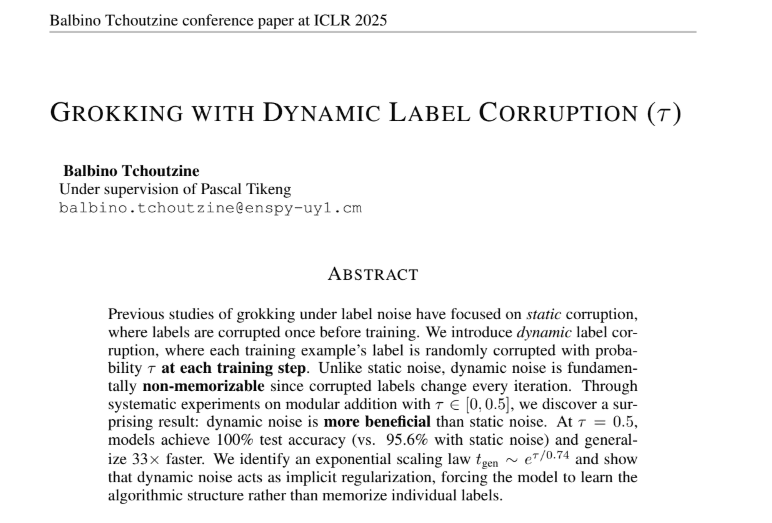
Previous studies of grokking under label noise focused on static corruption (labels corrupted once before training). We introduce dynamic label corruption, where each label is randomly corrupted with probability τ at each training step.
Unlike static noise, dynamic noise is fundamentally non-memorizable since corrupted labels change every iteration. Our experiments reveal that dynamic noise acts as implicit regularization, forcing models to learn the algorithmic structure rather than memorize individual labels.
Static vs. Dynamic Noise
STATIC NOISE (ξ):                       DYNAMIC NOISE (τ):
──────────────────                      ──────────────────
Labels corrupted ONCE                   Labels corrupted EVERY STEP
before training                         during training

Epoch 1: [3, 4, 2, 5, 9, 8]              Step 1: [3, 4, 2, 5, 1, 8]
Epoch 2: [3, 4, 2, 5, 9, 8] ← same       Step 2: [3, 7, 9, 5, 1, 0] ← different!
Epoch 3: [3, 4, 2, 5, 9, 8] ← same       Step 3: [1, 7, 2, 5, 6, 8] ← different!

→ Memorizable                           → NON-memorizable
Main Results
1. Dynamic vs. Static Comparison
At 50% noise, dynamic corruption achieves perfect generalization while static corruption fails completely.
2. Training Dynamics
The model learns the true function (clean accuracy at 100%) while training accuracy on noisy labels converges to the theoretical value (1-τ) + τ/C.
3. Scaling Law
Generalization time follows an exponential scaling law: t_gen ~ exp(τ/0.74), with R² = 0.981.
4. Characteristic Times
Both memorization and generalization times increase with τ, but generalization remains achievable up to τ = 0.5.
Summary Table
| τ | SNR | t_mem | t_gen | Δt | Train Acc | Test Acc |
|---|---|---|---|---|---|---|
| 0.00 | ∞ | 250 | 300 | 50 | 100.0% | 100.0% |
| 0.10 | 864 | 300 | 350 | 50 | 100.0% | 100.0% |
| 0.20 | 384 | 350 | 400 | 50 | 100.0% | 100.0% |
| 0.30 | 224 | 350 | 450 | 100 | 100.0% | 100.0% |
| 0.40 | 144 | 400 | 550 | 150 | 100.0% | 100.0% |
| 0.50 | 96 | 450 | 600 | 150 | 100.0% | 100.0% |
Theoretical Insights
Signal-to-Noise Ratio
SNR = (1-τ)(C-1) / τ
For p = 97 and τ = 0.5: SNR = 96, the true label appears 96× more often than any single wrong label.
Maximum Training Accuracy
Acc_train_max = (1-τ) + τ/C
The model cannot exceed 51% on noisy labels at τ = 0.5, confirming it learns the rule, not the noise.
Hyperparameters
| Parameter | Value |
|---|---|
| Modulus p | 97 (prime) |
| Hidden dimension | 128 |
| Optimizer | AdamW |
| Learning rate | 10⁻³ |
| Weight decay | 1.0 |
| Training steps | 20,000 |
| Train/test split | 50% / 50% |
Related Work
This study builds upon our previous analysis of static label noise: ξ-Grokk: Analyzing Grokking Dynamics in the Presence of Noise.
Key references:
- Power et al. (2022): Grokking: Generalization beyond overfitting on small algorithmic datasets
- Liu et al. (2023): Omnigrok: Grokking beyond algorithmic data
Source code: github.com/zoom-BT/T_Grokk Kaggle notebook: kaggle.com/code/balbinotchoutzine/t-grokk Full document: View the paper