Introduction
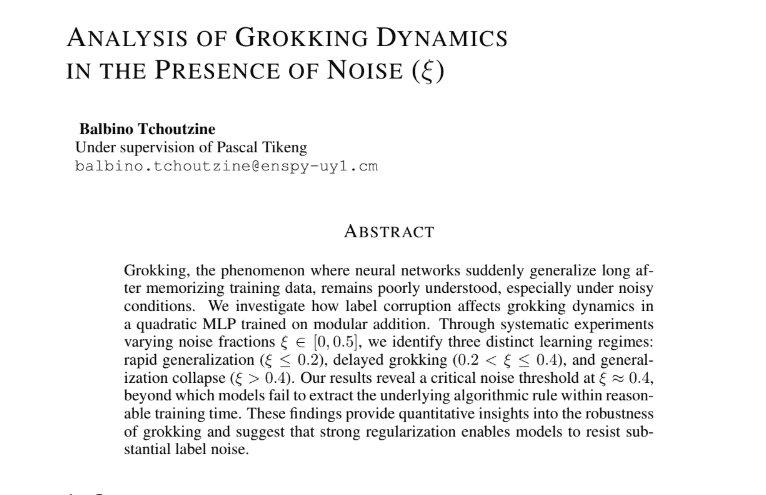
This project studies the impact of the fraction of corrupted labels (ξ) on the learning dynamics of a quadratic MLP trained on a simple task: modular addition m + n (mod p).
The main goal is to quantify how noise affects:
- Memorization: the time (t_mem) needed for the model to memorize the training data (clean and noisy)
- Generalization (grokking): the time (t_gen) needed for the model to generalize to the test set, often well after memorizing the training set
- Performance: final metrics (accuracy and loss) on the training and test sets
Key Results as a Function of ξ
The analysis reveals a strong correlation between increasing noise (ξ) and the evolution of the learning dynamics, particularly the grokking phase.
Memorization and Generalization Time
The impact of noise on t_gen is striking: generalization time increases exponentially once ξ exceeds 0.2, showing that the training time cost to extract the general rule grows considerably with noise.
Inversion Phenomenon (Grokking)
The training curves for ξ = 0.20 and ξ = 0.35 clearly illustrate grokking:
- Fast memorization: training accuracy and clean-data accuracy quickly reach 100% (around 100 steps)
- Delayed generalization (grokking): test accuracy stays low during the memorization phase, then suddenly jumps during the generalization phase, at the observed t_gen
- Memorization vs. generalization: the gap between the point where training error approaches zero and the point where generalization improves is the signature of grokking: increasing ξ widens this gap
Interpretation: The Role of Regularization
The fact that the model manages to memorize clean data (t_mem_clean ≈ 100 steps) while delaying generalization shows that it favors learning the general rule (the solution that works for clean data) over superficially memorizing noisy labels, which increases test loss.
Using strong regularization (weight decay = 1.0) seems to encourage the network to find this simple, generalizable structure, letting it push past noise up to a certain threshold (ξ ≈ 0.40). Beyond this threshold, noise becomes too dominant: the model memorizes everything, and generalization collapses.
Conclusions
- Critical threshold: the model tolerates up to ξ ≈ 0.40 of corrupted labels before generalization is compromised
- Phase transition: between ξ = 0.20 and ξ = 0.40, a transition from fast generalization to pronounced grokking is observed
- Collapse: at ξ = 0.50, the model can no longer extract the underlying rule in a reasonable time
Future Work
- Study the impact of other hyperparameters (learning rate, architecture) on these dynamics
- Explore noise detection and filtering strategies to improve robustness
- Analyze internal representations to understand how the model distinguishes signal from noise
Source code: github.com/zoom-BT/Grokk Full document: View the paper
License: MIT