
Research & Publications
My research work in applied AI: foundations, alignment, prediction
Leakage-Resistant Models for MCI-to-Dementia Conversion Risk Prediction
Balbino Tchoutzine• July 24, 2026Ongoing
Pre-engineering research internship: building leakage-resistant models for 2-5 year MCI-to-dementia conversion risk prediction across the NACC, ADNI, and Framingham cohorts.
View details →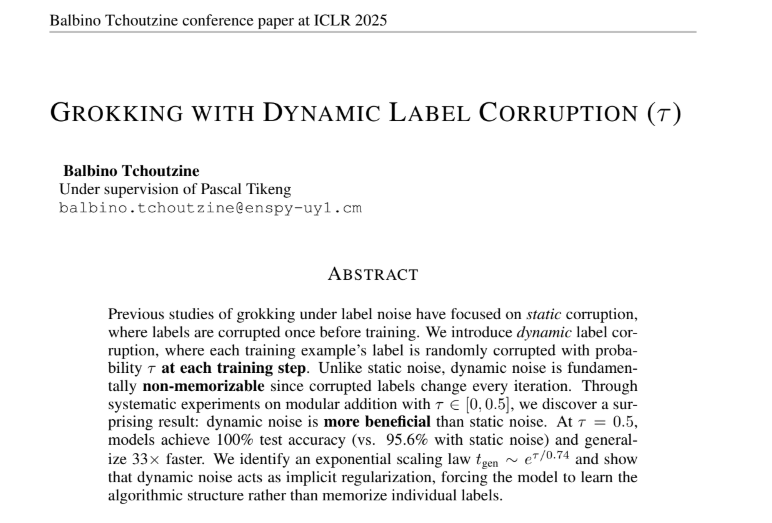
T-Grokk: Dynamic Label Noise Favors Grokking
Balbino Tchoutzine• February 1, 2026Unpublished
Unlike static noise, corrupting labels at every training step (dynamic noise) acts as implicit regularization: at 50% noise, the model reaches 100% test accuracy versus a complete failure under static noise.
View details →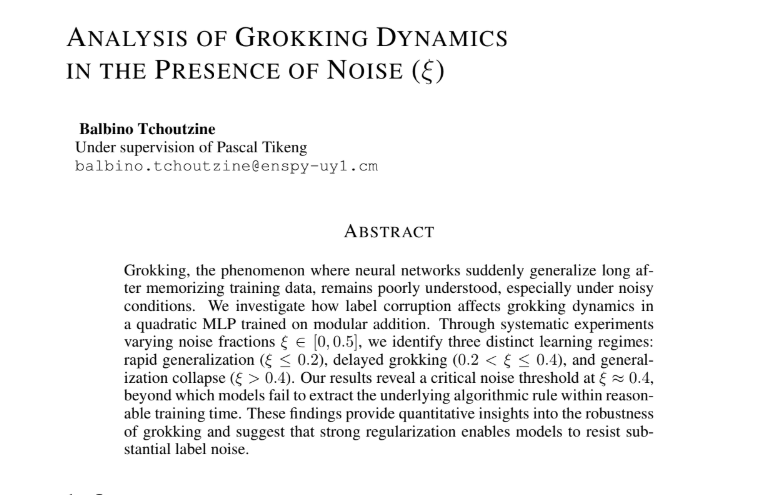
Analyzing Grokking Dynamics in the Presence of Noise (ξ)
Balbino Tchoutzine• November 1, 2025Unpublished
How the fraction of corrupted labels (ξ) affects memorization and generalization (grokking) in an MLP trained on modular addition, up to a critical threshold where the model collapses.
View details →Research Interests
- Foundations of deep learning and learning dynamics (grokking, robustness to label noise)
- Alignment and fine-tuning of foundation models
- Long-horizon clinical prediction (dementia 2 to 5 years out, from early diagnostics and MRI)
- Computer vision and multimodal learning
- Geospatial ML and foundation models for Earth observation
- Low-resource NLP / speech (African languages as a demanding testbed)
- Competitive and large-scale applied machine learning